I was standing on the corner of 5th and Main at 3:45 AM, shivering in a light drizzle, watching a little digital car on my screen dance in circles three blocks away. According to the app, my driver was “approaching,” yet the street was eerily silent. No headlights. No engine hum. Just the sound of my own rising anxiety because that flight to London wasn’t going to wait for a ghost. I’d made the classic mistake of assuming that a glowing pixel on a map equaled a physical vehicle in motion. That night, I learned the hard way that location spoofing isn’t just a tech-bro conspiracy theory; it’s a real-world headache that ruins schedules and compromises your safety. I felt foolish standing there, but it was a lightbulb moment: the app is a tool, not an absolute truth.
When Your Screen Says Arriving but the Street Stays Empty
We have all been there. You have a tight schedule and you have done the right thing by looking for the only way to ensure your 4 am ride actually shows up, only to realize the driver might be playing games with their GPS to secure a fare they can’t actually reach in time. It is a gut-punch. Today, I am going to show you exactly how to spot these digital tricks so you are never left stranded again. I spent years trusting every notification my phone pinged at me, until one particularly disastrous morning when I missed a major keynote because my “approaching” driver was actually sitting at a coffee shop five miles away using a spoofing app. The driver wanted the booking fee but wasn’t ready to work. The problem is that we want to believe the tech. We want to believe that the accuracy test for modern live-tracking links is foolproof. But drivers sometimes use “joystick” apps to trick their phone’s operating system into thinking they are at a specific coordinate. This helps them jump the queue at airports or grab lucrative “on-demand” pings without actually being in the area. Have you ever stood on a curb watching a “ghost” car circle the block on your screen while the street stayed empty? If so, you have likely been a victim of location spoofing.
Can You Really Trust the Map in Your Hand?
It is natural to be skeptical. After all, isn’t the GPS supposed to be satellite-accurate? Well, here is a surprising fact: security researchers at the University of Texas at Austin have repeatedly demonstrated that civilian GPS signals are unencrypted and easily “spoofed” with relatively cheap hardware and software. In the world of ride apps, this means a driver can appear to be right around the corner while they are actually finishing a lunch break across town. Early on, I used to blame my own phone. I would toggle my Wi-Fi, restart the app, and assume I was just seeing the real reason your tracking link might be lagging. I was wrong. I was ignoring the clear signs of manipulation, like a car “teleporting” across three lanes of traffic or moving at 80 mph through a school zone on the map. Learning how to spot a driver who is ignoring the tracking map is your first line of defense. By the time we are done today, you will know how to cross-reference the app’s claims against physical reality, ensuring your next reservation is as solid as a rock. Let’s look at the red flags that usually go unnoticed until it is too late.
Start Your Security Audit Before the Car Pulls Up
To stop being a victim of ‘ghost cars,’ you must move from being a passive observer to an active auditor of your own transportation. The first time I successfully caught a spoofing attempt, I was headed to a wedding in Seattle. I noticed the car icon on my screen was traveling at a constant 60mph regardless of stop signs or traffic lights on the map. I called the driver, and his voice was far too calm for someone supposedly navigating the Friday afternoon rush. I canceled immediately and booked a professional service instead. This level of vigilance starts the second you open the app or receipt.
Verify the Digital Paperwork First
The most common point of failure isn’t the car; it is the data link. Before you even step out the door, you need to know how to confirm your secure booking link is using https. If the link looks suspicious or lacks that ‘S,’ your data—and your real-time location—are vulnerable to interception. It is also vital to understand how to spot a secure payment portal before you book. A driver using a spoofing app is often a driver who is also cutting corners on data security. If the booking interface looks ‘off’ or asks for excessive permissions, back out.
Watch the Map for Impossible Physics
Once the ride is accepted, keep the map open. Real drivers in real traffic move with stuttered progress—they wait at lights, they slow down for turns, and they occasionally miss a lane. If you see a vehicle ‘teleporting’ across blocks or moving through buildings, you are seeing more than just a bad signal. You might be seeing the real reason your tracking link might be lagging: the driver is using a joystick app to manually ‘drive’ their GPS pin toward you while they finish a task elsewhere. I always apply the buffer rule that actually prevents tardy starts by scheduling my ‘virtual’ pickup ten minutes before my actual hard deadline. This gives me a window to catch these digital anomalies without missing my appointment. 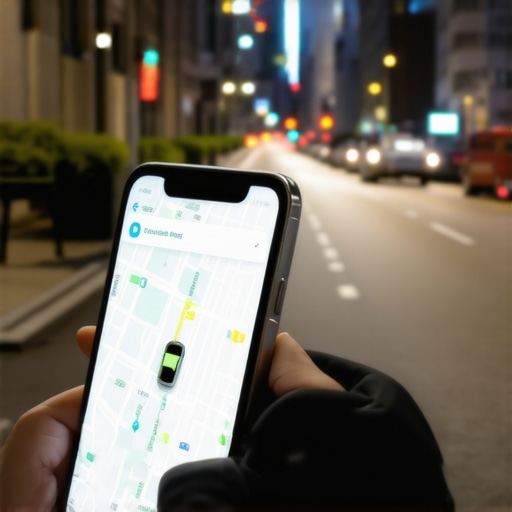
Confirm the Physical Credentials on Site
When a car finally pulls up, the verification process shifts from digital to physical. Don’t just look for the make and model. Look for 3 red flags to watch for when your car arrives, such as mismatched plates or a driver who doesn’t know your name. This is where you verify the human element. Specifically, you should know how to read a drivers commercial badge for authentic credentials. A professional chauffeur will have their permit visible and won’t be offended when you check it. This is why why verified driver badges matter more for late night travel; they are the physical proof that the person behind the wheel is who they say they are, regardless of what the digital map claimed ten minutes ago. Always cross-reference the face in the app with the face in the seat before you ever open the door.Most people think that the ‘Expected Time of Arrival’ (ETA) on their screen is a hard commitment. It isn’t. In fact, one of the biggest myths in modern travel is that an algorithm can account for the sheer unpredictability of human behavior. I used to think that if the app said ten minutes, I could walk out the door in nine. But I quickly realized that the real reason your apps eta is often over-optimistic is because these systems prioritize selling you the ride over the cold, hard reality of urban congestion. A study by the Victoria Transport Policy Institute highlights that travel time reliability is often compromised by ‘non-recurrent congestion’—accidents, weather, or events—that automated systems struggle to predict in real-time. This is why the logic behind choosing a professional chauffeur over on-demand apps becomes so clear when your career or a flight is on the line.
Does Your Driver Actually Know the Shortcuts Algorithms Miss?
We’ve reached a point where we trust the blue line on the screen more than the person behind the wheel. That’s a mistake. A professional driver understands why on-time performance depends on local knowledge over GPS. They know which intersections become bottlenecks at 2 PM when schools let out, or which side streets are currently undergoing unmapped utility repairs. When you rely solely on a satellite, you’re missing the human intuition that prevents a delay from becoming a disaster. I’ve seen passengers fall into the trap of booking multiple short trips to save a few dollars, but the hidden costs of multiple ride-hailing requests vs hourly hire go beyond the financial. You lose the continuity of service. If your first driver is late, your entire schedule collapses like a house of cards. 
Stop Betting Your Schedule on an Algorithm’s Best Guess
The ‘oops’ factor usually hits when travelers assume that ‘point-to-point’ is the most efficient way to handle a busy afternoon. It’s a common trap. You think you’re being precise, but in reality, you’re resetting your risk of a ‘ghost car’ with every new booking. This is exactly why point-to-point booking fails for executive roadshows or tight multi-stop itineraries. You aren’t just paying for the miles; you’re paying for the readiness. By choosing an hourly arrangement, you ensure the driver’s only priority is your timeline, not the next ‘ping’ in their queue. Remember why consistent arrival times matter more than the shortest route: it’s about the peace of mind that comes from knowing the car is already there, rather than hoping the algorithm finds someone nearby. Have you ever fallen into this trap? Let me know in the comments.
Maintaining a perfect record of on-time arrivals isn’t just about picking the right app; it is about building a system that treats your time like the finite resource it is. I have transitioned from someone who ‘hopes the car shows up’ to someone who audits the entire process. The shift happened when I realized that most travelers are using 20th-century habits to manage 21st-century tech. To keep this working for the long haul, you need a digital toolkit that bridges the gap between your schedule and the driver’s reality. I personally swear by direct calendar integration. You should learn how to sync your calendar directly with your chauffeur to eliminate the manual data entry errors that cause 15% of missed pickups.
How do I maintain a reliable transit system over time?
Consistency is the byproduct of strict protocols. I have a ‘Three-Click Audit’ I perform for every reservation. First, I check the security of the portal. Second, I verify the driver’s specific credentials. Third, I set a secondary alert for the tracking link. You must understand that even the best tech has limitations; for instance, why your real-time tracking link might have a 30-second lag is often due to server-side ‘smoothing’ that hides small deviations in the car’s path. By expecting this lag, you won’t panic when the icon doesn’t move for half a minute. I also make it a habit to check the physical health of the fleet I use. Look for the one physical marker that proves a vehicle is well-maintained, such as the condition of the tire sidewalls and the clarity of the headlight lenses. A company that skips the car wash is likely skipping the oil change too.
Beyond the vehicle, you have to vet the business behind the wheel. I never get into a car without knowing how to verify a private vehicles commercial insurance in seconds. It is as simple as asking to see the digital insurance card and checking for the ‘Commercial’ designation. This is the line between a hobbyist and a professional. We have to remember that why background checks are only the baseline for professionalism; they don’t guarantee that the driver knows the nuances of executive service or how to audit your drivers route history for accuracy and safety. I use specialized route-tracking software to review my trips after the fact, ensuring I am not being overcharged for ‘scenic’ routes. According to LCT Magazine, the gold standard for ground transportation involves rigorous daily fleet inspections that gig-economy apps simply cannot enforce at scale. This gap is where your safety lives.
Looking toward the future, I predict we are going to see a massive shift back toward ‘human-verified’ routes. AI is great at calculating the shortest distance, but it still fails to understand that a certain street might be blocked by a neighborhood block party or a local parade that isn’t on a map yet. The next evolution of premium travel will be ‘Intuitive Routing,’ where professional drivers use hyper-local data to bypass even the ‘smartest’ GPS suggestions. Stop letting a glowing screen dictate your peace of mind. For your very next trip, I challenge you to skip the on-demand gamble and book an hourly professional; compare the difference in your stress levels when the driver is waiting for you, rather than the other way around.
The Hard Truths I Learned While Waiting on Empty Curbs
The most painful lesson I have absorbed over a decade of travel is that the ‘sunk cost fallacy’ is a traveler’s worst enemy. We often stay on the curb for twenty minutes because we have already invested ten minutes waiting, even as the ‘ghost car’ on the screen spins in circles. I eventually realized that the real cost of choosing the cheapest reservation available is measured in missed flights and shattered peace of mind. Now, if a driver doesn’t move for three minutes or displays impossible physics, I cancel immediately.
I also learned that ‘on-demand’ is often code for ‘unsynchronized.’ Professional services operate on a completely different logic. You truly see why safety and timeliness matter in hourly reservation services when you stop being a ‘ping’ on a map and start being a client with a dedicated chauffeur. It is a shift from playing a digital lottery to securing a physical guarantee.
My final lightbulb moment? Technology is a supplement, not a substitute for human accountability. A GPS can tell you where a car is, but it can’t tell you the driver’s intent. Only a verified, professional reservation provides that level of certainty.
My Personal Strategy for Never Missing a Connection
I have narrowed my travel routine down to three non-negotiables that ensure I am never the person running through the terminal in a panic. First, I always ensure my booking includes my specific arrival details; I have found that why flight numbers are the best delay insurance for your ride is because it shifts the burden of tracking onto the professional. They see the delay before you even land.
Second, I use the 12-minute rule for international airport pickups, which provides enough of a buffer for baggage claim without leaving the driver waiting in an expensive dead zone. Finally, I never rely on the app’s internal verification alone. I have mastered 7 tactics to verify your drivers commercial license in seconds, which includes a quick check of the rear-view permit. These habits don’t just keep you on time; they keep you secure.
Take Back Control of Your Daily Schedule
You deserve to arrive at your destination feeling composed and ready, not depleted by logistical stress. The transition from being a passive passenger to an empowered traveler happens the moment you stop trusting the algorithm more than your own eyes. By prioritizing professional standards over the lottery of on-demand apps, you are investing in your own productivity. Don’t be afraid to demand higher standards for your on-time arrival. Your time is your most finite resource—treat it that way.
Have you ever had a driver ‘ghost’ you when you needed them most? Let me know your story in the comments below.