I was standing on my curb at 4:00 AM, clutching a lukewarm latte and staring at the taillights of a sedan that looked fine from my front porch. I tossed my bags in, we pulled away, and within two miles, the cabin filled with the acrid scent of burning oil. I ended up stranded on the shoulder of the interstate, watching my flight departure window shrink to zero. It was a classic rookie mistake. I had focused so much on why a 4 AM reservation needs extra planning that I completely ignored the vehicle itself until it was too late. Now, I do not care how tired I am or how much of a hurry the driver seems to be in; I have a non-negotiable ritual. Today, I want to walk you through exactly how to vet your ride in under a minute so you never have to experience that sinking stomach feeling on the highway. We are going to ensure your safety and your schedule remain intact by looking at the details that most travelers miss.
Stop Treating Your Ride Like a Magic Carpet
The biggest lie we tell ourselves is that a high price tag or a fancy app interface guarantees a well-maintained machine. It does not. A vehicle is a complex collection of thousands of parts working in harmony—or, in some cases, barely hanging on by a thread. Early in my travel days, I once ignored a faint grinding sound because I did not want to be that guy who questioned a professional. Big mistake. I eventually learned that the brake pad squeal you should never ignore before a long trip is the car’s way of begging for a day off. If you do not advocate for your own safety, nobody else will. You should always feel empowered to take a moment and how to check a vehicles safety rating before you book your ride, but the real work starts when the car is physically in front of you.
Is a sixty-second walkaround actually worth the effort?
You might think you are being paranoid, but the data says otherwise. According to the National Highway Traffic Safety Administration (NHTSA), nearly 2% of all vehicle crashes are directly linked to mechanical failures, with tires and brakes topping the list of culprits. When you are paying for a premium service, you are paying for a vehicle that passes the windshield wiper test and has tires with actual tread left. A quick glance at the wheels and a sniff of the interior air can tell you more about the driver’s professionalism than a five-star rating ever could. Before you even touch the door handle, you should already know if that car is fit for the journey. Have you ever felt that immediate vibe that something was mechanically off the moment you sat down? Following the essential hourly reservation tips for timely service starts with ensuring the car can actually make the trip.
Look for the Telltale Signs of Neglect
I have noticed that a driver who ignores a cracked side mirror or a flickering headlight is often the same driver who ignores his oil change intervals. It is about a mindset of precision. In the next few minutes, I will show you how to scan the body of the car, check the tires without looking like a mechanic, and verify the interior climate before you ever commit to the seat.
Walk the Perimeter Before You Load the Trunk
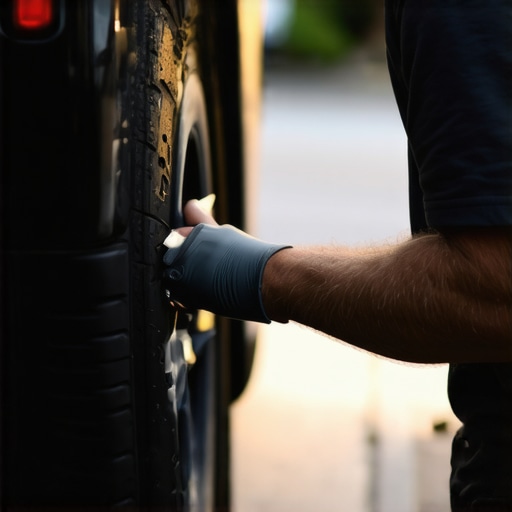
When your car pulls up, your first instinct is to toss your bags in the trunk and collapse into the seat. Resist that urge. I take a quick lap around the vehicle, starting from the passenger rear and moving clockwise. I am looking for the obvious: hanging trim, fluid leaks forming on the pavement, or body damage that suggests the car has been in a recent scrape. If a company can’t bother to fix a bumper, they aren’t likely to prioritize the professional vehicle fleet standards you are paying for. I remember a trip to Chicago where I noticed a massive bulge on the sidewall of the front-left tire while the driver was opening the trunk. Had I just hopped in, that tire likely would have shredded on the Kennedy Expressway at 70 mph. Instead, I pointed it out, the driver was horrified—he hadn’t seen it—and we swapped vehicles. That sixty-second walk saved my afternoon and potentially my life.
Tires Reveal the Truth About Fleet Care
You do not need to be a mechanic to judge a tire. Look at the tread. If the tires look like racing slicks, the vehicle’s stopping distance is compromised, especially in the rain. A well-maintained car is the foundation of safety and precision for reliable hourly reservations. While you are down there, glance at the rims. Curb rash is common, but deep gouges suggest a driver who isn’t careful with the vehicle’s dimensions. This is also the perfect time to how to spot a genuine commercial license plate instantly. In most cities, these plates are the only way to verify the car is properly insured for hire. If it’s a standard passenger plate, you are essentially riding in a stranger’s personal car without the legal protections of a commercial policy.
Confirm the Identity and Professionalism of Your Chauffeur
Once the exterior passes the eye test, look at the person behind the wheel. A professional should be alert, well-groomed, and ready to assist. If the driver looks like they just rolled out of bed, they might be. It is vital to verify your driver is not exhausted before you head out on a long leg of a trip. I always ask a simple, open-ended question like, “How has the traffic been for you today?” This isn’t just small talk; I am checking for mental clarity, responsiveness, and any scent of tobacco or alcohol. A pro will have a clear answer and a focused demeanor. If they seem confused or sluggish, that is your cue to reconsider the ride.
Audit the Cabin Environment Before the Door Closes
When you finally step inside, the interior tells the final part of the story. Does the air conditioning actually work? Is the cabin clean? I always perform the floor mat check to see if the driver takes pride in their workspace. Beyond cleanliness, check the safety features. If you are traveling with family, you should always verify the child lock protocol if needed. Finally, once you are moving, listen for those odd sounds. You want a silent, smooth glide, not a chorus of rattles. This ensures the company is following through on how to ensure your hourly driver stays within safe speed limits and maintaining the mechanical integrity of the car.Most travelers assume that being “on time” is a binary state: either the car is there at 4:00 AM, or it is not. However, in my years of high-stakes travel, I have learned that if your driver is arriving exactly at the reservation time, they are already late. A true professional operates on a different clock entirely. Everyone says the app is the ultimate source of truth, but in my experience, the digital map is often a deceptive comfort. Real reliability is built on a foundation of pre-arrival protocols that most passengers never see. This is where safety and precision for reliable hourly reservations truly begins—long before the ignition is even turned on.
The Trap of Trusting Your Tracking App
We have become addicted to watching the little car icon crawl across our smartphone screens. The “oops” factor here is massive. I once sat in a hotel lobby watching my driver’s icon hover three blocks away for fifteen minutes. When I finally called, the driver was actually parked on the opposite side of the building because of a GPS glitch. You have to understand why refreshing your tracking app might give you false arrival times; the latency in cellular data can create a dangerous illusion of progress. This is precisely why manual reservation checks outperform automated bots every single time. A human dispatcher knows the bridge is closed for construction; a server in a data center might not catch that for another twenty minutes.
Does a 15-minute buffer actually keep you safe?
In professional logistics, this is known as the “On-Time Performance” (OTP) margin. According to a report by the Bureau of Transportation Statistics, congestion in major hubs is increasingly unpredictable, making a standard ten-minute buffer obsolete. If you are not seeing your driver communicate their status at least fifteen minutes prior, your schedule is at risk. I have found that precise reservation timing requires more than just a calendar entry; it requires a proactive confirmation. Have you ever fallen into this trap where the app said the car was “just around the corner” while your flight was boarding? Let me know in the comments.
Stop Betting Your Flight on a Digital Signal
The biggest mistake I see executives make is falling for the “Confirmation Illusion.” They get a generic email and assume the mission is a go. But the danger of relying on verbal confirmations for important travel or unverified automated pings cannot be overstated. You need a paper trail or a digital receipt that proves a vehicle has been dispatched, not just requested. This level of planning is what separates a successful trip from a chaotic one. Some people try to outsmart the system by why double booking a backup ride is a sign of a planning failure, but that usually just leads to more confusion and wasted money. Instead, focus on the quality of the initial reservation. When you prioritize a service that understands the nuance of city traffic and mechanical redundancy, you aren’t just buying a ride; you’re buying the certainty that you will actually arrive on the curb with time to spare.It is a hard truth to swallow, but your iPhone is often the weakest link in your travel chain. While it is perfect for checking emails, it is a poor substitute for professional-grade logistics tools. When I am booking a high-stakes trip, I look for a fleet that has moved beyond consumer apps. This is exactly why we use dedicated gps hardware instead of smartphone apps in the professional world. Dedicated units have high-gain antennas that do not lose signal under a bridge or between skyscrapers, ensuring that on-time every-time strategies for safe and reliable hourly bookings are actually possible rather than just a marketing slogan.
Stop gambling with consumer-grade navigation apps
The precision you need for a 4 AM airport run comes from why real-time vehicle data is more accurate than estimated times. I have seen countless ‘on-demand’ drivers miss a turn because their phone lagged for three seconds. A professional system is hardwired into the vehicle’s ODB-II port, providing a constant stream of location and speed data. This level of technical oversight is part of the ISO 39001 standards for Road Traffic Safety Management, which niche experts use to minimize risk. By using hardware that monitors the vehicle health and speed in real-time, the company can proactively manage why driver speed alerts are the backbone of passenger safety. Beyond the car, the dispatch software is the silent engine of your punctuality. A professional dispatch center is far superior to a simple automated algorithm. You can learn how to spot a professional dispatch center from a call center by the quality of their communication. Real pros use software that integrates automatic re-routing for city travel to bypass accidents before the driver even sees the brake lights ahead. This ensures you are mastering the art of reservation and safety every hour by relying on human-monitored technology.
How can you keep your travel schedule bulletproof month after month?
Maintaining this level of consistency requires a shift from ‘hoping for the best’ to ‘verifying the facts.’ I suggest building a relationship with a service that understands reservation security measures how to book safely and arrive on time. Over time, you will notice that staying secure and punctual the essential hourly reservation tips for timely service becomes second nature. I predict the future of this industry will involve deep geofencing. Imagine a world where your driver is automatically alerted the moment your plane touches the tarmac, not just when it lands. This is why geofencing is the best way to keep your family safe during transit and represents the next leap in scaling reliability. If you want to take your travel game to the next level, I challenge you to do one thing on your next booking: why you must demand a physical copy of your trip reservation or a detailed digital PDF. It forces the company to commit to the details in writing, leaving no room for app glitches. If you have questions about setting up these advanced protocols, contact us to learn more about our standards.
The Hard Truths Learned from a Decade on the Curb
After thousands of miles in the back of various sedans, I have realized that the most expensive ride is the one that never arrives—or the one that breaks down halfway there. One “lightbulb moment” occurred when I realized that being a polite passenger shouldn’t come at the expense of my own security. It is better to be the person who asks one too many questions than the person waiting for a tow truck on the shoulder. Here is what I have learned through trial and error: a driver’s attitude toward their trunk space usually reflects their attitude toward the engine. While digital apps provide convenience, staying secure and punctual requires actual human oversight. Finally, always trust your nose; a cabin that smells like neglect usually is exactly that.
The Travel Toolkit That Keeps My Schedule Bulletproof
I do not just wing it anymore. My personal protocol involves three specific layers of protection that I trust implicitly. First, I use professional-grade flight tracking tools to cross-reference my arrival times against the driver’s status. Second, I always make sure to demand a physical copy of your trip reservation because digital signals fail, but ink on paper or a downloaded PDF does not. Finally, I maintain a direct line to a human dispatcher who can override an algorithm if traffic gets messy. This combination is how I maximize safety and satisfaction with precise reservation timing every single time.
Take Command of Your Next Journey
Travel should be about the destination, not the anxiety of the transit. By taking sixty seconds to vet your vehicle and another two minutes to confirm your logistics, you are reclaiming your time and your safety. When you prioritize safety and precision for reliable hourly reservations, the road ahead looks a lot clearer. You deserve the confidence that comes with a professionally managed ride. To see how we handle these high-standard protocols first-hand, feel free to contact us to discuss your next trip. Have you ever spotted a mechanical red flag just before a big trip? Share your story in the comments below.