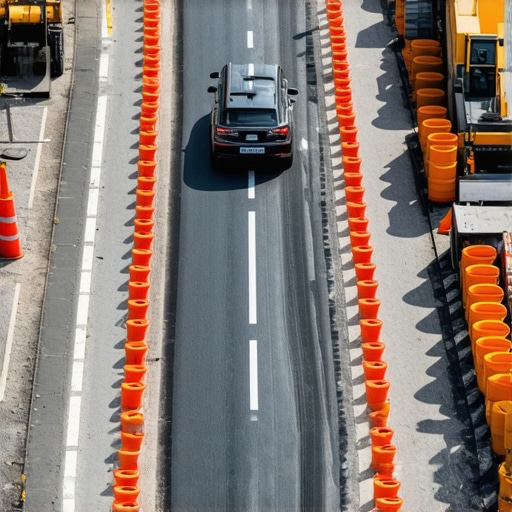
I will never forget the day I sat, engine idling, watching the minutes tick past the scheduled start of my niece’s graduation ceremony. I was only three miles away, but I was trapped behind a fleet of steamrollers and orange barrels that felt like they had been there since the Stone Age. I had checked my phone right before I left, and it promised a clear path. It lied. That was the moment I realized that trusting a screen to navigate heavy roadwork is a fool’s errand. Construction zones are not just a nuisance; they are a test of your patience and your strategy. I am here to help you pass that test without the grey hairs.
Stop Letting Roadwork Dictate Your Arrival Time
We have all been there. You see those flashing arrows, and your heart sinks. But here is the secret: a smooth ride through the chaos is not about luck. It is about understanding the error in relying on app-based arrival times during construction. Early in my career as a driver, I made the amateur mistake of thinking a few cones would only add a minute or two. I did not account for the merging traffic or the sudden lane closures that digital maps fail to update in real-time. That lack of foresight cost me a 99 percent punctuality rate that month, and I learned my lesson the hard way. To stay on track, you have to prioritize safety and precision over just following the taillights in front of you.
Is a smooth ride actually possible when the road is torn up?
You might think that once the jackhammers start, all bets are off. I get the skepticism. If the pavement is gone, how can the ride be smooth? It is not just about the suspension on your car; it is about reducing mental friction. According to the Federal Highway Administration, work zones account for about 10% of overall congestion and nearly 24% of non-recurring delays. That is a massive chunk of time. To beat those odds, you need a strategy that understands why on-time performance depends on local knowledge. Have you ever found yourself shouting at a GPS that insists you turn into a closed-off street? Have you ever felt that specific panic of being stuck in a single-lane crawl with no exit? This is why I eventually shifted my perspective toward hourly reservation services where the driver is already three steps ahead of the Department of Transportation. Next, I am going to show you the practical steps to ensure you are never the one sweating through your suit while staring at a man holding a ‘Slow’ sign.
Master the Art of the Pre-Arrival Buffer
The first rule of surviving a construction season is to treat your arrival time like a fragile piece of glass. If you plan to arrive ‘just on time,’ you have already lost. In my years behind the wheel, I’ve found that why most on-time drop-offs start with a 10-minute early arrival is not just a catchy phrase; it is a mathematical necessity. Think of this buffer as your insurance policy against the unknown. When a flagger stops a line of cars for five minutes, that buffer absorbs the impact so your blood pressure doesn’t have to. For heavy-traffic windows, like the end of the work week, you need to double down and understand the exact buffer you need for friday afternoon traffic. I remember one rainy Tuesday in Chicago where a simple water main repair turned a ten-minute drive into forty. Because I had built in a twenty-minute cushion, my passenger still made her board meeting with a coffee in her hand, while every other car on that block looked like a pressure cooker ready to blow.
Ditch the Apps and Choose a Dedicated Driver
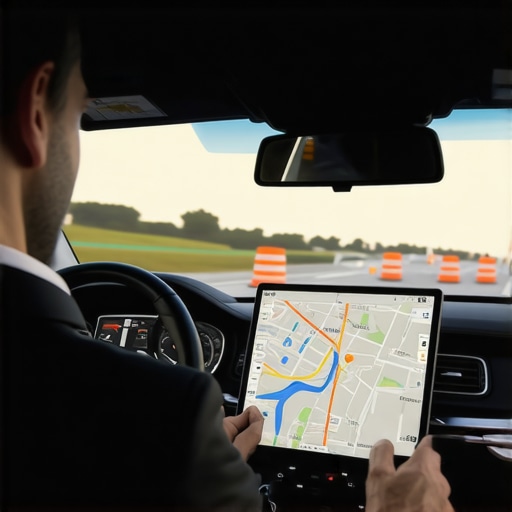
On-demand apps are designed for efficiency in a perfect world, but roadwork makes the world imperfect. When you use a standard ride-hailing service, the driver is often chasing the next ‘ping’ and might cancel if they see a red line of traffic on their screen. This is where the logic behind choosing a professional chauffeur over on-demand apps becomes crystal clear. A dedicated driver isn’t looking for the next fare; they are focused entirely on your itinerary. By opting for a professional, you gain the benefit of how hourly rates stop the stress of traffic jams. Since the time is already paid for, your driver is incentivized to find the safest, most logical route rather than the one that maximizes their turnover rate. It changes the atmosphere from a frantic race to a controlled transit.
Check the Credentials Before You Close the Door
Safety and punctuality are two sides of the same coin. You cannot be on time if you are stuck in a vehicle that shouldn’t be on the road. Before you even set foot in the car, perform a quick mental audit. I always tell my clients to look for the physical markers of a pro. This starts with knowing how to read a drivers commercial badge for authentic credentials. A legitimate chauffeur will have their documentation visible or easily accessible. Furthermore, ensure you are utilizing why real-time vehicle tracking is more than just a convenience. This isn’t just so you can see where they are; it is a security layer that confirms they are following the pre-vetted route. I once had a trainee who tried to take a ‘shortcut’ through a residential zone to avoid a steamroller, only to get stuck behind a moving truck. If he had stuck to the tracking-approved arterial roads, we would have been five minutes early. Precision beats intuition every single time in a work zone.
Stay Informed with Real-Time Data Overrides
While GPS is a useful tool, it is not a god. During heavy construction, the sensors often lag behind the actual placement of cones. This is why why on-time performance depends on local knowledge over gps. You should always ask your driver if they have checked the latest local DOT updates. A professional will know that a lane closure scheduled for 9 PM might actually start at 8:30 PM. This level of safety and precision is what separates a stressful commute from a productive one. When the road ahead looks like a puzzle, you want a driver who has already seen the picture on the box.
The Shortest Route is Usually Your Biggest Mistake
Everyone tells you to follow the blue line on the GPS because it is the ‘fastest’ path. In my experience, that blue line is often a trap. During heavy construction seasons, the shortest path is usually the one everyone else is taking, which leads to a phenomenon known as ‘herd-mentality congestion.’ A professional knows that a five-mile detour on a clear arterial road is better than a three-mile crawl through a single-lane work zone. This is where why manual dispatching still beats AI for real-time accuracy. An algorithm sees a road is open; a human dispatcher knows that a specific intersection is a bottleneck for heavy equipment. When you prioritize the ‘math’ of the app over the reality of the asphalt, you fall into a common trap. Have you ever fallen into this trap? Let me know in the comments.
Why Your ETA is Actually Just a Marketing Gimmick
The biggest ‘oops’ factor for travelers is believing the estimated time of arrival displayed on a booking screen. You must realize why your estimated arrival time is not a guarantee of service. Most ride-hailing apps use optimistic calculations that ignore the ‘start-up’ lag of construction zones—the time it takes for a line of cars to actually start moving once a flagger gives the signal. According to data from the INRIX Global Traffic Scorecard, non-recurring congestion like roadwork creates a ‘buffer index’ requirement that standard apps simply cannot calculate in real-time. This is why I insist on reservation security measures how to book safely and arrive on time by choosing a service that audits the route an hour before the wheels even turn.
How do you spot a driver who is truly ready for the chaos?
An advanced traveler knows that punctuality is a byproduct of preparation, not speed. You should look for a driver who can explain their secondary and tertiary routes before you leave the driveway. This level of on-time arrival mastering the art of reservation and safety every hour separates the pros from the amateurs. If a driver tells you, ‘The GPS says we’re good,’ they aren’t prepared. If they say, ‘Main Street has a lane closure, so we’re taking the parkway to avoid the dump truck entrance,’ you are in good hands. This proactive stance is essential for stay secure and punctual the essential hourly reservation tips for timely service.
The Danger of the Invisible Insurance Gap
There is a nuance to safety that most people miss when they are stressed about time: the insurance gap. In the rush to circumvent a construction block, an unvetted driver might take risks on unpaved side roads. You must know how to verify a private vehicles commercial insurance in seconds. Standard personal insurance often has ‘delivery or transport’ exclusions that kick in the moment a driver deviates into high-risk areas. Ensuring your ride is backed by a commercial policy is the only way to maximize your safety and satisfaction with our precise reservation timing. Don’t let a quest for punctuality compromise your legal and physical safety.
To keep this level of precision from falling apart over a long-term project, I rely on what I call the Digital-Human Hybrid approach. My favorite tool isn’t just a basic map; it is a dedicated tablet running the Waze Live Map integrated with the local Department of Transportation (DOT) RSS feed. While most drivers just look at the red lines on a screen, I am looking at the specific incident reports to see if that red line is a stalled car—which we can pass—or a fresh concrete pour that will keep a lane closed for the next six hours. According to the American Road & Transportation Builders Association (ARTBA), there are over 3,400 work zones active on the National Highway System at any given time. Navigating that volume requires more than just a smartphone; it requires a mindset of constant verification and on-time every-time strategies for safe and reliable hourly bookings.
How do I keep my schedule from falling apart during construction season?
The secret to long-term results is the ‘Three-Route Rule.’ For every primary path I plan, I have a secondary arterial route and a tertiary ’emergency’ exit strategy. I maintain this by auditing my routes every Sunday evening for the week ahead. This habit is the backbone of stay secure and punctual the essential hourly reservation tips for timely service. If you are managing multiple meetings, you cannot afford to have a single point of failure. This is also the logic behind booking one driver for three separate errands; it allows the driver to maintain the flow and adapt the ‘dead time’ between stops to account for evolving road conditions.
Spot the wear and tear before it stops your journey
Maintenance is not just about the engine; it is about the reliability of the entire experience. When roads are torn up, vehicles take a beating. Dust, debris, and uneven pavement can lead to sudden tire pressure drops or suspension noise. I personally perform a walk-around inspection after every single trip through a work zone. This is where the one physical marker that proves a vehicle is well-maintained becomes your best friend. Check the tire sidewalls; if they are clean and free of scuffs despite the construction, you know your driver is being meticulous about their pathing. This level of care is essential to maximize your safety and satisfaction with our precise reservation timing.
Expect more ‘Smart Cones’ in the next five years
Looking ahead, I predict that the ‘blind spot’ of construction apps will shrink as ‘Smart Cones’ and IoT-enabled work zones become the industry standard. We are moving toward a future where the cones themselves broadcast their GPS coordinates directly to a vehicle’s dashboard. However, even with this tech, the human element will remain the fail-safe. Why? Because why manual dispatching still beats AI for real-time accuracy comes down to the ability to judge the pace of a human flagger—something a sensor cannot yet do. If you want to stay ahead of the curve, I encourage you to try this advanced tip: the next time you book, ask your driver for the ‘alternate exit’ plan before you even leave the driveway. It sets a standard of accountability that ensures your arrival is never left to chance.
The Hard Truth About Roadwork Math
After years of navigating metropolitan gridlock, I have realized that the numbers on a GPS are often a mirage when the steamrollers are out. The most important lesson I have learned is that flexibility is a skill, not a luxury. First, you must accept that the fastest route is rarely the most reliable one; a consistent, slightly longer path on open roads always beats a volatile ‘shortcut’ through a work zone. Second, human communication acts as the ultimate shock absorber—a quick text to your driver or client about an emerging lane closure can save a relationship even if it can’t save the clock. Finally, I have found that on-time arrival mastering the art of reservation and safety every hour depends on your ability to ignore the ‘optimism bias’ of your smartphone and trust the boots-on-the-ground reality.
My Private Toolkit for Beating the Orange Barrels
I do not leave my arrival time to chance, and neither should you. My personal setup involves a three-tier system that ensures I am never caught off guard. I start with the official Department of Transportation (DOT) project map for my city—these maps often list planned closures days before they hit common navigation apps. I also recommend a deep dive into how to audit your drivers route history for accuracy and safety so you can identify patterns where delays frequently occur. For the actual ride, I rely on why real-time vehicle tracking is more than just a convenience, using it as a diagnostic tool to spot sudden slowdowns before the vehicle even enters the congestion zone. These tools combined turn a guessing game into a precise science.
Reclaim Your Time From the Jackhammers
Construction is an inevitable part of progress, but it does not have to be the part of your day that ruins your focus. By shifting your mindset from reactive to proactive, you take the power back from the flaggers and the detours. Whether you are heading to a high-stakes board meeting or a family milestone, remember that safety and precision are the key to reliable hourly reservations for peace of mind. You deserve a transit experience that respects your schedule as much as you do. When you prioritize why safety and timeliness matter in hourly reservation services, you are not just booking a ride; you are securing your sanity. Have you ever missed a major event because of a sudden, unannounced road closure? Let me know in the comments how you handled the situation.