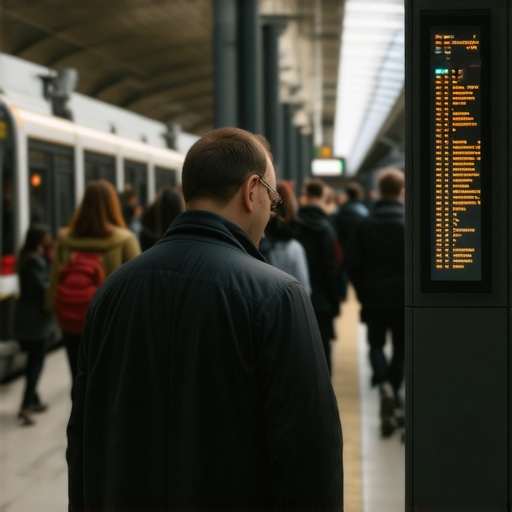
I will never forget the rainy Tuesday I tried to be efficient by taking the 8:05 train for a 9:00 AM meeting across town. I stood there, soaking wet, watching three ‘Out of Service’ cars roll by while the digital clock mocked me. I ended up calling a ride-share that cost four times the usual rate because of surge pricing. It was a disaster, and it happened because I trusted a static schedule during the most volatile time of the day. If you are like me—someone who does not commute every single day—you probably treat the transit schedule like a holy text. You look at the app, see a time, and plan your life around it. But during peak hours, that schedule is more of a suggestion than a rule. High-frequency periods are actually where the system is most likely to break down. Between ‘ghost buses’ that never appear and trains that are too full to board, the casual traveler is often the first one left behind.
Why Your Morning Commute Feels Like a Gamble
I want to help you stop being the person standing on the platform looking at their watch in despair. Today, we are going to look at why these systems fail and how you can take control of your time by using the reliable way to time your commute during peak hours. We will explore why most arrival times are simply guesses and how to build a backup plan that actually works. Early in my journey, I made the mistake of thinking that if I just left five minutes earlier, I would be safe. I was not. I did not account for how road construction or simple human error ripples through a peak-hour grid. I learned the hard way that fixed schedules are not always what they seem when the sheer volume of commuters hits a boiling point.
Is the Reliable Transit System Just a Myth?
According to a study by TransitCenter, service reliability is the single biggest factor in rider satisfaction, yet it is the first thing to go when traffic hits. Have you ever missed a vital connection because a guaranteed bus just did not show up? It is incredibly frustrating. But what if you could bypass that uncertainty entirely? By shifting your mindset from waiting for a ride to reserving your time, you can ensure your safety and punctuality regardless of what the city throws at you. We are going to dive into how to manage your logistics so you never have to explain a late arrival to your boss again. We will cover the buffer that saves you from missing the train and why mastering the art of reservation is the neighborly advice you actually need.
Build a Recurring System That Saves Your Morning
One of the most effective ways to remove the gambling aspect of your commute is to set up a recurring weekly commute that never fails. This isn’t just about convenience; it’s about locking in a professional who understands your specific route and timing needs. I once spent three months using the same driver for my Wednesday airport runs. Because we had a system, he already knew how to use the best back roads to avoid the bridge construction that standard navigation apps often missed. This level of consistency is why hourly booking is more reliable than ride-hailing apps. You aren’t just getting a ride; you are securing a teammate who is as invested in your arrival as you are.
Take Control by Managing Your Own Logistics
Stop letting an algorithm decide if you make it to your meeting on time. When you rely on a standard ride-hailing app, you are at the mercy of whatever driver happens to be nearby and willing to accept your fare for a low margin. Instead, moving to a model where you have strategies for safe and reliable hourly bookings gives you the steering wheel. Think of it like this: a typical app is like a crowded public pool where everyone is splashing for space, whereas an hourly reservation is your own private lane. I learned this the hard way during a torrential downpour last October. I had a keynote to give and the estimated wait time on my phone kept jumping from 4 minutes to 22 minutes. I finally realized that a human dispatcher outperforms an AI every time because they can anticipate the weather’s impact on local traffic patterns, whereas the app just reacts when it is too late.
Why the 17-Minute Buffer is the New Gold Standard
Forget the old advice about leaving fifteen minutes early. In a city where a single double-parked delivery truck can paralyze three blocks, you need more breathing room. I have found that the 17-minute buffer outperforms the traditional 15-minute rule because it accounts for the last mile variance—the time it takes to actually find your driver, verify the vehicle, and get moving. This isn’t just about being early; it is about ensuring safety and punctuality by removing the rush. When you are hurried, you make mistakes, like hopping into the first black sedan that pulls up without checking the details.
Check the Credentials Before You Get In
Safety isn’t a passive experience; it is an active checklist you must follow every time. Before I even touch a door handle, I perform a quick visual sweep of the vehicle. You need to know how to verify commercial plates on a private hire to ensure the vehicle is actually insured and regulated for passenger transport. I once had a driver show up in a vehicle that looked right, but the plates were standard passenger tags, meaning I wouldn’t be covered in an accident. By sticking to the protocol for verifying your chauffeur’s permit, I avoided a potentially dangerous ride. This is why professional punctuality requires a pre-trip inspection—it protects both your schedule and your physical well-being. If you are traveling in a new area, you should also know how to identify a safe drop-off point so you aren’t left on a dark corner. By mastering these small habits, you transform from a vulnerable passenger into a prepared traveler who arrives with total peace of mind.
Beyond just the physical vehicle, there is a technical layer of deception that most travelers fall for: the ‘live tracking’ screen. We’ve all been there, staring at a little car icon on a map, assuming it represents reality. But here’s the contrarian truth: that blue dot is often a digital ghost. I’ve learned that the difference between live tracking and estimated progress can be the gap between making your meeting and standing on the sidewalk apologizing to a dial tone. The issue is GPS latency and the ‘urban canyon’ effect. A 2023 study by *The Journal of Navigation* notes that in dense city centers, GPS signals can bounce off glass buildings, creating errors of up to 50 meters. This is why GPS lag can ruin your meeting schedule before you even leave the lobby.
Most people think the app is their friend because it’s ‘real-time,’ but they miss the nuance of infrastructure. Professional outfits ensure why our drivers never use unverified navigation apps. Why? Because an algorithm doesn’t know a street is closed for a block party until three cars have already gotten stuck. This is why safety and timeliness matter in hourly reservation services—you need a human brain filtering the data. Have you ever fallen into this trap where the ‘5-minute wait’ stays ‘5 minutes’ for a quarter of an hour? Let me know in the comments.
Why Does My Driver Keep Taking the Longer Route?
It’s tempting to look at a driver’s chosen path and think you know better because of a map on your phone. But an advanced mistake is micromanaging a professional who is prioritizing safety over speed. For instance, I used to get annoyed when drivers took the highway instead of side streets, until I realized they were avoiding high-pedestrian zones where accidents are statistically higher. You have to learn how to verify the commercial validity of a transit schedule and trust the training. A professional knows why you need a direct line to your hourly driver to discuss these choices in real-time. Researchers at MIT found that standard routing algorithms often fail to account for ‘micro-events’—like a double-parked truck—until several vehicles have already been delayed. This is yet another reason why a human dispatcher outperforms an AI every time.
Don’t Be a Beta Tester for a Tech Company’s Algorithm
The biggest ‘oops’ factor I see is travelers failing to stay secure and punctual by ignoring the driver’s physical state. We focus so much on the car that we forget the person. An exhausted driver is as dangerous as a faulty brake line. You should know how to spot a driver who is too tired to drive safely. If they are leaning on the door, rubbing their eyes, or struggling with simple navigation, speak up. Even when you are trying to learn how to get an on-time pickup during a summer storm, safety can never be sacrificed for the clock. Trust your gut over the app’s ‘guaranteed’ arrival time. Real reliability isn’t just about showing up; it’s about arriving in one piece.
It is one thing to survive a single chaotic morning; it is another to build a system that works every time you have a high-stakes meeting. To move from a lucky traveler to a logistics pro, you need to stop guessing and start auditing. I treat my travel like a business expense, and that means I look at the data. I have found that why real-time vehicle data is more accurate than estimated times provided by standard apps. I personally use a combination of FlightAware for my arrival status and local DOT traffic cameras. Why the cameras? Because seeing the brake lights on the I-95 bridge myself is the only way to verify if a dispatcher’s reroute is genuine or just a guess.
How do I maintain a reliable commute system month after month?
The secret is the monthly audit. Every four weeks, I sit down and look at my travel logs. I have learned how to audit your monthly travel spend without stress, looking for patterns in delays. If a specific pickup point always adds ten minutes, I adjust my reservation. This is also when you should how to check for hidden fees in your ride confirmation. A service fee that fluctuates is a red flag that your provider is using dynamic pricing behind your back. By keeping your records clean, you ensure that why on-time performance is the only metric that matters remains the focus of your service provider.
My Secret Toolbox for Total Schedule Control
I do not just rely on the driver’s GPS. I maintain a direct line of communication. According to the *Texas A&M Transportation Institute’s Urban Mobility Report*, the planning time index is the most important factor for commuters—it represents the total travel time you should allow to ensure on-time arrival. To hit that 95% reliability mark, I use a dedicated logistics app that integrates my calendar with local transit alerts. This allows me to stay secure and punctual even when my schedule shifts last minute.
The Future of Ground Transport Isn’t Just Robots
We hear a lot about self-driving cars, but the real future of reliability is human-in-the-loop logistics. Algorithms can find the shortest path, but they cannot negotiate a safe drop-off point during a protest or a parade. I predict that we will see a shift back toward high-touch reservation services where technology handles the tracking, but humans handle the exceptions. You can maximize your safety and satisfaction with our precise reservation timing by leaning into this hybrid model today. Do not wait for the technology to be perfect; use the tools available now to reclaim your time. Try auditing your last three rides today—look for exactly where the estimated time and actual time diverged. It is the first step to never being late again.#IMAGE_PLACEHOLDER_E#
Three Hard-Earned Truths About Professional Ground Travel
Reflecting on my years spent navigating unpredictable city traffic, I have realized that true reliability is built on a few non-negotiable foundations. First, the cheapest option usually carries a hidden tax of stress and delay; investing in reserving your spot with a professional is the only way to guarantee your peace of mind. Second, always assume the ‘estimated time’ is a best-case scenario that rarely accounts for the reality of urban friction. Finally, I’ve learned that why last-minute reservations often result in poor quality—it’s because quality requires preparation, vehicle staging, and route planning that can’t happen in a sixty-second dispatch window.
My Go-To Resources for a Stress-Free Morning
I don’t just wing it anymore; I use a specific stack of tools to ensure I never miss a beat. For high-stakes meetings, I rely exclusively on hourly bookings because the dedicated attention is irreplaceable. I also use a strict set of reservation security measures to ensure my data and my physical safety are never compromised. To keep things running smoothly, I check the local DOT traffic cameras to verify what the sensors are claiming, and I always know how to spot an unlicensed operator before getting in a vehicle. These habits might seem extra, but the first time you bypass a three-hour gridlock, they will feel like a superpower.
Take Your Time Back Today
The transition from a frustrated commuter to a relaxed traveler happens the moment you decide that your time is too valuable to leave to an algorithm. By prioritizing why hourly drivers offer better mental clarity for busy executives, you are not just buying a ride; you are buying the ability to focus, prepare, and arrive at your best. Don’t let another ‘Out of Service’ sign or a ghost bus ruin your day. What was the one commute disaster that finally made you realize you needed a better plan? Let me know in the comments below.